


Immunoprecipitation Market: Current Landscape and Growth Outlook
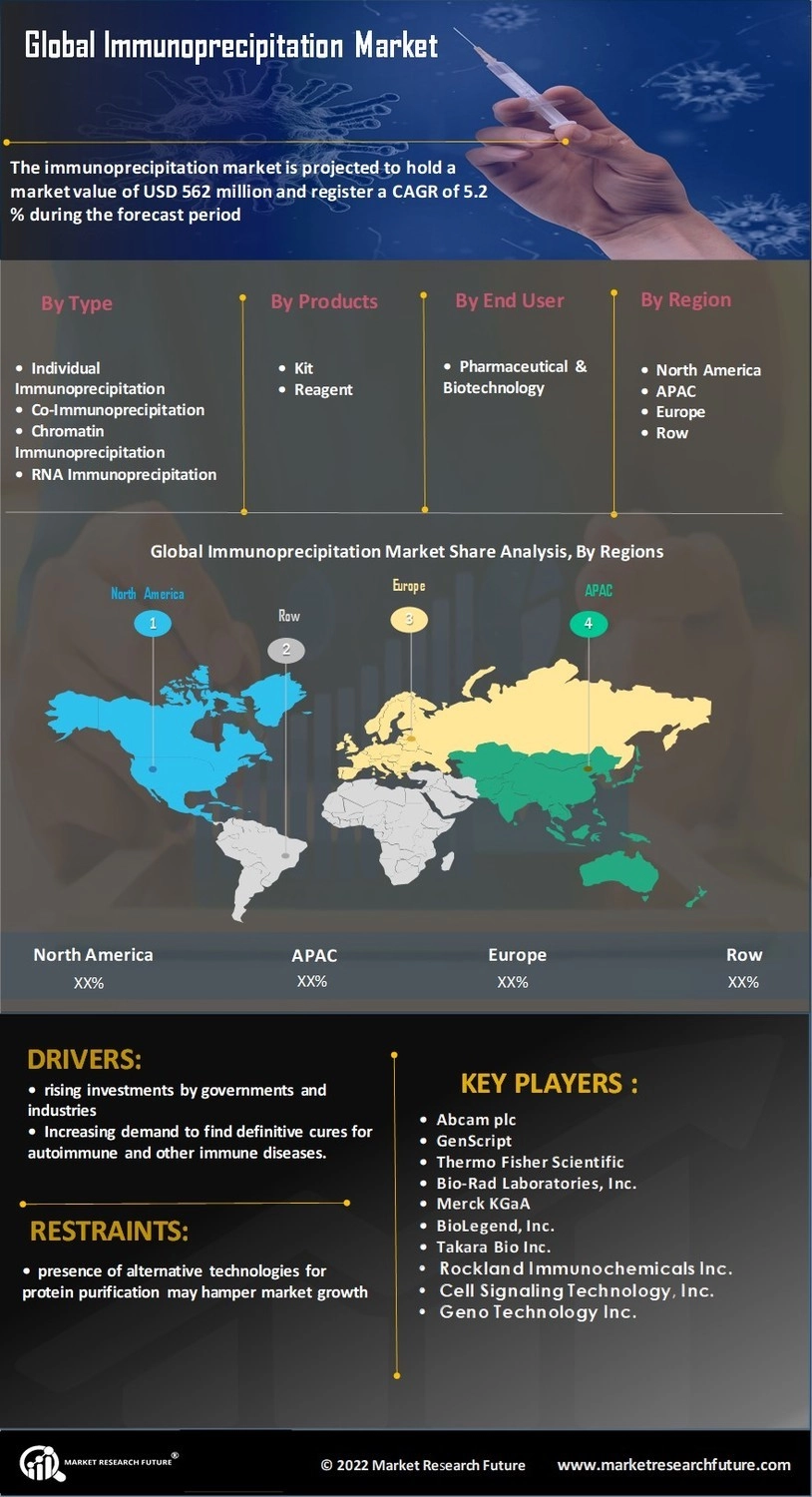
The global immunoprecipitation market — which includes antibodies, reagents, kits, magnetic beads and associated consumables and instruments used for protein–antibody capture techniques such as co-immunoprecipitation (Co-IP) and chromatin immunoprecipitation (ChIP) — has matured into a steady, research-driven segment of the life-science tools industry. Recent market research places the market valuation at roughly USD $750 million in 2023, with expected mid-single-digit annual growth through the rest of the decade.
Get full Reports:https://www.marketresearchfuture.com/reports/immunoprecipitation-market-7816
Driving factors behind this expansion are clear: rising global R&D spending in pharmaceuticals and biotechnology; widespread use of immunoprecipitation in proteomics, biomarker discovery, epigenetics (ChIP) and drug-target validation; and growing adoption of higher-throughput, kit-based workflows that simplify traditionally labor-intensive protocols. These trends increase demand not only for core reagents (antibodies, beads) but also for validated kits and integrated workflows that accelerate reproducible results in academic labs, CROs and pharma companies.
Regionally, North America leads in revenue share thanks to heavy academic and industrial R&D investment, with Europe and Asia-Pacific (notably China and India) showing the fastest uptake as research infrastructures expand and local reagent manufacturing scales up. Growth in Asia-Pacific is being driven by increasing biotech funding, expanding clinical research activity, and greater instrument/consumable localization to reduce costs and lead times.
Competitive dynamics center on a mix of large life-science vendors and specialized reagent/kit providers. Major players frequently cited in market analyses include Thermo Fisher Scientific, Merck KGaA (MilliporeSigma), Bio-Rad Laboratories and Abcam — companies that combine broad antibody portfolios with validated kits and technical support to capture institutional buyers. Smaller niche suppliers and startups focusing on next-generation affinity reagents, automation-friendly kits, or ChIP-seq library prep also create acquisition and partnership opportunities for larger firms.
Looking ahead, the immunoprecipitation market’s most promising opportunities lie in: (1) continued migration from in-house IP protocols to validated kits and automation-compatible reagents, (2) expansion of ChIP and other IP-linked sequencing workflows, and (3) growth in proteomics and multi-omics programs that integrate IP with mass spectrometry and sequencing. Challenges will include reagent reproducibility, antibody specificity concerns, and pricing pressure as competitors commoditize basic consumables. For researchers and suppliers alike, investments in validation data, technical support, and bundled workflows will be decisive competitive levers.
The global immunoprecipitation market — which includes antibodies, reagents, kits, magnetic beads and associated consumables and instruments used for protein–antibody capture techniques such as co-immunoprecipitation (Co-IP) and chromatin immunoprecipitation (ChIP) — has matured into a steady, research-driven segment of the life-science tools industry. Recent market research places the market valuation at roughly USD $750 million in 2023, with expected mid-single-digit annual growth through the rest of the decade.
Get full Reports:https://www.marketresearchfuture.com/reports/immunoprecipitation-market-7816
Driving factors behind this expansion are clear: rising global R&D spending in pharmaceuticals and biotechnology; widespread use of immunoprecipitation in proteomics, biomarker discovery, epigenetics (ChIP) and drug-target validation; and growing adoption of higher-throughput, kit-based workflows that simplify traditionally labor-intensive protocols. These trends increase demand not only for core reagents (antibodies, beads) but also for validated kits and integrated workflows that accelerate reproducible results in academic labs, CROs and pharma companies.
Regionally, North America leads in revenue share thanks to heavy academic and industrial R&D investment, with Europe and Asia-Pacific (notably China and India) showing the fastest uptake as research infrastructures expand and local reagent manufacturing scales up. Growth in Asia-Pacific is being driven by increasing biotech funding, expanding clinical research activity, and greater instrument/consumable localization to reduce costs and lead times.
Competitive dynamics center on a mix of large life-science vendors and specialized reagent/kit providers. Major players frequently cited in market analyses include Thermo Fisher Scientific, Merck KGaA (MilliporeSigma), Bio-Rad Laboratories and Abcam — companies that combine broad antibody portfolios with validated kits and technical support to capture institutional buyers. Smaller niche suppliers and startups focusing on next-generation affinity reagents, automation-friendly kits, or ChIP-seq library prep also create acquisition and partnership opportunities for larger firms.
Looking ahead, the immunoprecipitation market’s most promising opportunities lie in: (1) continued migration from in-house IP protocols to validated kits and automation-compatible reagents, (2) expansion of ChIP and other IP-linked sequencing workflows, and (3) growth in proteomics and multi-omics programs that integrate IP with mass spectrometry and sequencing. Challenges will include reagent reproducibility, antibody specificity concerns, and pricing pressure as competitors commoditize basic consumables. For researchers and suppliers alike, investments in validation data, technical support, and bundled workflows will be decisive competitive levers.
Immunoprecipitation Market: Current Landscape and Growth Outlook
The global immunoprecipitation market — which includes antibodies, reagents, kits, magnetic beads and associated consumables and instruments used for protein–antibody capture techniques such as co-immunoprecipitation (Co-IP) and chromatin immunoprecipitation (ChIP) — has matured into a steady, research-driven segment of the life-science tools industry. Recent market research places the market valuation at roughly USD $750 million in 2023, with expected mid-single-digit annual growth through the rest of the decade.
Get full Reports:https://www.marketresearchfuture.com/reports/immunoprecipitation-market-7816
Driving factors behind this expansion are clear: rising global R&D spending in pharmaceuticals and biotechnology; widespread use of immunoprecipitation in proteomics, biomarker discovery, epigenetics (ChIP) and drug-target validation; and growing adoption of higher-throughput, kit-based workflows that simplify traditionally labor-intensive protocols. These trends increase demand not only for core reagents (antibodies, beads) but also for validated kits and integrated workflows that accelerate reproducible results in academic labs, CROs and pharma companies.
Regionally, North America leads in revenue share thanks to heavy academic and industrial R&D investment, with Europe and Asia-Pacific (notably China and India) showing the fastest uptake as research infrastructures expand and local reagent manufacturing scales up. Growth in Asia-Pacific is being driven by increasing biotech funding, expanding clinical research activity, and greater instrument/consumable localization to reduce costs and lead times.
Competitive dynamics center on a mix of large life-science vendors and specialized reagent/kit providers. Major players frequently cited in market analyses include Thermo Fisher Scientific, Merck KGaA (MilliporeSigma), Bio-Rad Laboratories and Abcam — companies that combine broad antibody portfolios with validated kits and technical support to capture institutional buyers. Smaller niche suppliers and startups focusing on next-generation affinity reagents, automation-friendly kits, or ChIP-seq library prep also create acquisition and partnership opportunities for larger firms.
Looking ahead, the immunoprecipitation market’s most promising opportunities lie in: (1) continued migration from in-house IP protocols to validated kits and automation-compatible reagents, (2) expansion of ChIP and other IP-linked sequencing workflows, and (3) growth in proteomics and multi-omics programs that integrate IP with mass spectrometry and sequencing. Challenges will include reagent reproducibility, antibody specificity concerns, and pricing pressure as competitors commoditize basic consumables. For researchers and suppliers alike, investments in validation data, technical support, and bundled workflows will be decisive competitive levers.
0 Commentaires
0 Parts
3KB Vue
0 Aperçu


 English
 Arabic
 Spanish
 Portuguese
 Deutsch
 Turkish
 Dutch
Dutch
 Italiano
 Russian
 Romaian
 Portuguese (Brazil)
 Greek
Greek